05 / CLOUD & DEVOPS / CASE STUDY
AWS Load Balancing & Auto Scaling
Exploring health-based routing and instance replacement on AWS.
Documented infrastructure lab Inspect source on GitHub ↗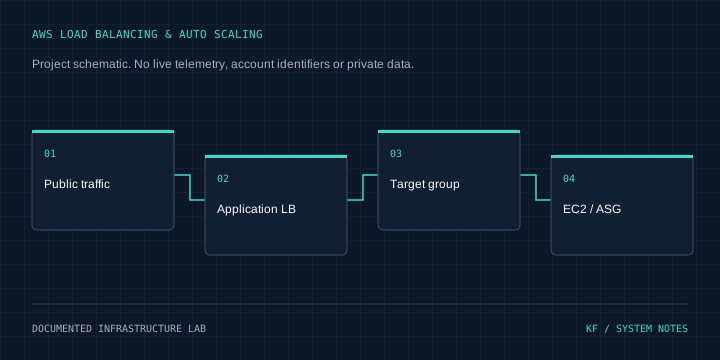
Architecture
Public traffic → Application LB → Target group → EC2 / ASG
Problem & context
A manually managed web server needs a traffic entry point and a repeatable replacement mechanism.
Objectives
Practice ALB target groups, launch templates, Auto Scaling and network access controls.
My role & project work
Configured a documented AWS web-tier lab using an ALB, EC2 launch template, Auto Scaling and target-group health checks.
Technical implementation
The repository describes the VPC, AMI/launch-template workflow, target group and scaling configuration. A reviewed console screenshot shows one registered target in Healthy state at capture time.
Engineering decisions
Use the target group as the traffic/health boundary and a launch template to make instance replacement repeatable. The documented minimum capacity is one; that does not establish continuously redundant multi-AZ capacity.
Challenges & solutions
The README describes troubleshooting an unreachable endpoint through ALB security-group rules and exercising instance replacement. The reviewed screenshot does not establish a failover duration.
Testing & verification
Reviewed README and target-group screenshots at revision 94f41812e27b4520f1890f93c4ae102c23662286. The tree contains documentation and images rather than infrastructure-as-code or the app.py mentioned in README.
Current status
Historical lab evidence. No present endpoint, uptime percentage, scale-out capacity or zero-downtime result is claimed.
Lessons & next steps
Health checks, target registration and scaling settings should be verified separately. Infrastructure-as-code and a recorded replacement drill would make the lab easier to reproduce.